Stafettpinnen går videre i Månedens antropolog! Dette er en spalte som løfter frem bredden, engasjementet og mangfoldet i norsk antropologi, både innenfor og utenfor akademia. Hver måned vil vi bli bedre kjent med en antropolog, deres arbeid, perspektiver og faglige drivkrefter. Månedens antropolog er også den som får sende ballen videre til den vi møter neste gang.
Månedens antropolog for juni er Jennifer Hays.
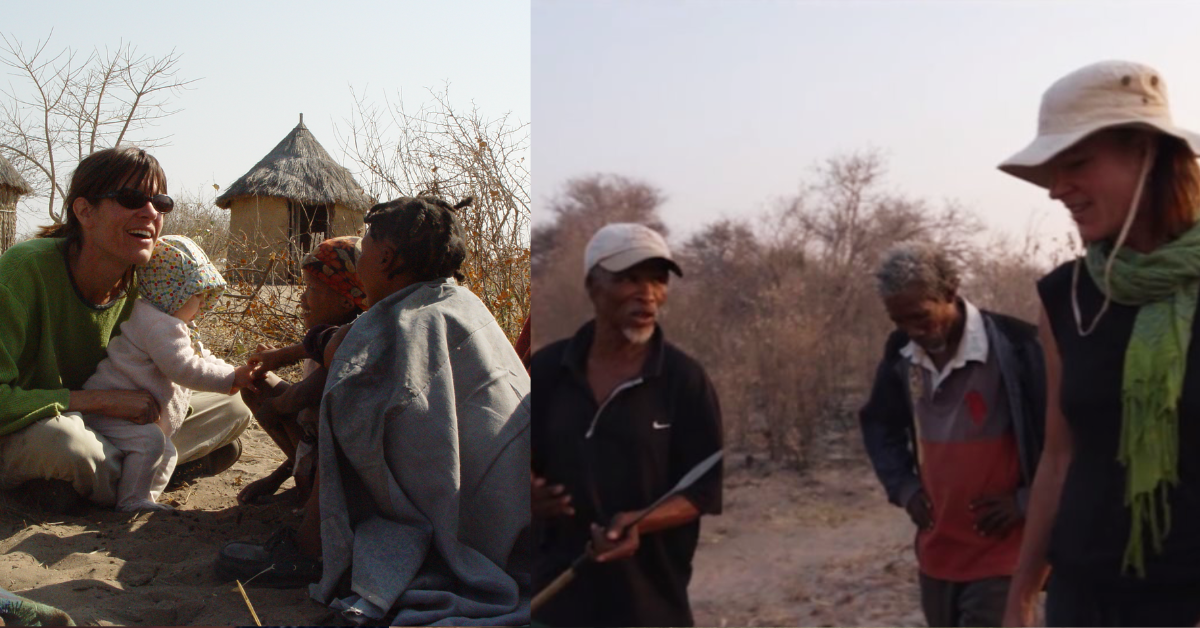
Bakgrunn: PhD – Cultural Anthropology, State University of New York (SUNY) – Albany
Nåværende stilling: Professor, UiT, Institutt for Sosialvitenskap (ISV)
Geografiske/tematiskeinteresser: southern Africa, human rights, Indigenous peoples, contemporary hunters and gatherers, formal education and traditional knowledge, biodiversity and conservation, participatory methodologies.
Hva inspirerte deg til å bli antropolog?
I actually did not even know what anthropology was until I was in my final year of university! I grew up in the United States, in upstate New York and Nebraska, and headed south to Texas for university, where I changed my course of study several times. As a senior I took an introductory course in anthropology as an elective (valgfritt kurs), and was hooked – especially by the concept of cultural and linguistic relativism and the work of Franz Boas and his contemporaries and students. It felt like a recognition – I saw my future as grounded in the field. I was also very interested in development studies, and in the 1980s there was a movement by thinkers like Robert Chambers towards greater participation of local people in the design, implementation, and assessment of projects in the so-called ‘third world’. This approach was revolutionary, but easily coopted and often simplistically implemented – it seemed extremely difficult to get it right. I was fascinated by this dynamic, and what the field of anthropology had to contribute to the question of how alternative cultures, worldviews, livelihoods, and visions for the future could have space to prosper within a dynamic where legitimacy was defined according to a capitalistic model.
My bachelor’s degree was a double major in International relations and French, but from there I went on to do my master’s in linguistic anthropology and my PhD in cultural anthropology at the State University of New York (SUNY) in Albany. I moved to Norway in 2007 for a post-doctoral position in Anthropology at the University of Tromsø.
Hvilken antropolog eller tenker har hatt størst innflytelse på ditt arbeide?
I have been thinking a lot lately about Antonio Gramsci’s concept of cultural hegemony and framework both for analysis and for activism. Gramsci provides powerful theoretical tools, but he was anything but a distanced intellectual; his most well-known writings, the Prison Notebooks, were written while he was imprisoned by the Italian fascist regime. His understanding of power was as something that is never absolute, but is always locked in a dynamic struggle with resistance. Hegemony exists when coercion and force are culturally legitimated through a process of consent, in which both the dominant and dominated groups alike accept the current order of things as somehow natural. In this model, the capacity to envision alternatives to current power structures becomes a central element of resistance. The foundational anthropological perspective of cultural relativism, and our field experiences grounded in participant observation provide platforms from which to question the societal consent that is usually taken for granted.
I would also mention the anthropologist’s daughter and science fiction author Ursula le Guin, in whose imaginary worlds we can recognize what it means to be human. In a 2014 speech accepting a National Book Foundation medal, she said: Hard times are coming, when we will be wanting the voices of writers who can see alternatives to how we live now, can see through our fear-stricken society and its obsessive technologies to other ways of being, and even imagine real grounds for hope. This has only become more urgent in the last decade, and clearly anthropologists have an important contribution to make to the recognition of other ontologies and ways of being in the world.
Hva jobber du med akkurat nå?
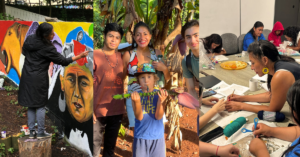
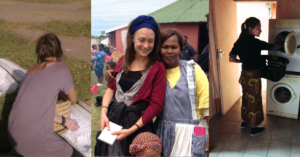
I am actually writing this post from the field, where I am working together with my husband, a human rights lawyer focusing on Indigenous land rights in southern Africa. Since 2000 I have been working with the Nyae Nyae Ju/’hoansi, an Indigenous San community in northeast Namibia, exploring interconnected questions relating to education, traditional knowledge, land rights, livelihood strategies, and food security. This is the only San community in southern Africa that has had the rights to practice their traditional hunting (with a small bow and poisoned arrows), and they have the most access to land on which to gather plant foods of any San group. However, these rights are increasingly threatened – by a recently imposed hunting ban, illegal poaching and land grabbing, and a variety of other interrelated forces.
In 2024 and 2025, I led an extensive ‘asset mapping study’ with a team of five Ju/’hoan youth, to better understand the communities’ current livelihood strategies, values, and priorities, with the aim of using this information to challenge the threats they are facing. We conducted extended focus group interviews in 36 villages, and the local team interviewed 1200 community members in an individual survey (these methods were of course complemented by long-term, and ongoing, participant observation). My husband and I are now building on the data collected over the past two years and working with that team and other community members on several related projects, including: making a film about people that were forcibly relocated in the 1970s and 1980s from what is now a national park; working on an emerging legal case involving local hunters who were arrested for ‘poaching’ after killing an animal through traditional methods, which they believed to be allowed; and facilitating a Biocultural Community Protocol process to strengthen their rights to land, resources, and culture.
Hva engasjerer deg mest – faglig eller ellers?
I don’t think I can separate ‘faglig’ and ‘ellers’! My experience with anthropology is not just as a discipline, it is a way of engaging with the world. So in a sense whatever my attention is drawn to, I approach it through an anthropological perspective. I think that what motivates me is the search for understanding what it means to be human, what is consciousness, how we are connected to each other and to other forms of life on our planet.
Hva er dine fremtidige planer eller prosjekter?
There is still a lot of work to be done with the projects described above. The Ju/’hoansi and other San communities are in the midst of an existential struggle, and they express deep concern. One man that I spoke with yesterday said “they want to take away our rights to hunt, now I am afraid that next they will take away our rights to gather our food from the bush. If we can no longer do these things, it is like we will not even be people anymore.” These issues are of course connected to much broader struggles, including those of other Indigenous peoples, and they are also connected with threats that affect all of humanity – climate change, biodiversity loss, food security. I am deeply committed to using my research over the past decades towards purposes that the communities I work with define, and to make broader arguments about the importance of all kinds of diversity – including human cultural and linguistic diversity – to our well-being as a species and to that of the planet.
Hva gjør du for å koble av?
Being out in nature, being physically active, and being with people whose company I enjoy – and any combination of these – are the things that work the best to restore my energy when I’m feeling low or stressed. I think that’s one of the reasons I thrive in Norway, because these activities are also highly valued in Norwegian culture. I also feel very fortunate that my job at the University of Tromsø and my research in southern Africa both include these elements too. This is great, because I enjoy my work, but it can sometimes feel like I’m never completely disconnected because my job is so integrated into my life! There are plusses and minuses to this – but I think that the positives outweigh the negatives.
Hvem vil du nominere videre?
Ingjerd Hoëm, University of Bergen. Her long-term fieldwork in Tokelau and close attention to the role of language in processes of change are an inspiration!